Home › Commercial Concrete Slabs and Flatwork
Get durable, level surfaces with commercial concrete slabs and flatwork in Atlanta, GA. We pour warehouse floors, equipment pads, loading areas, and sidewalks designed to handle heavy use. Our crews use proper reinforcement, joint layouts, and finishing techniques for long lasting performance.
Superior Concrete Atlanta provides professional commercial concrete slab throughout Atlanta, GA, Georgia and the surrounding area. Our licensed, insured crew delivers safe, clean, on-time work with a free estimate before anything begins. Call (470) 748-3052 or request your free quote.
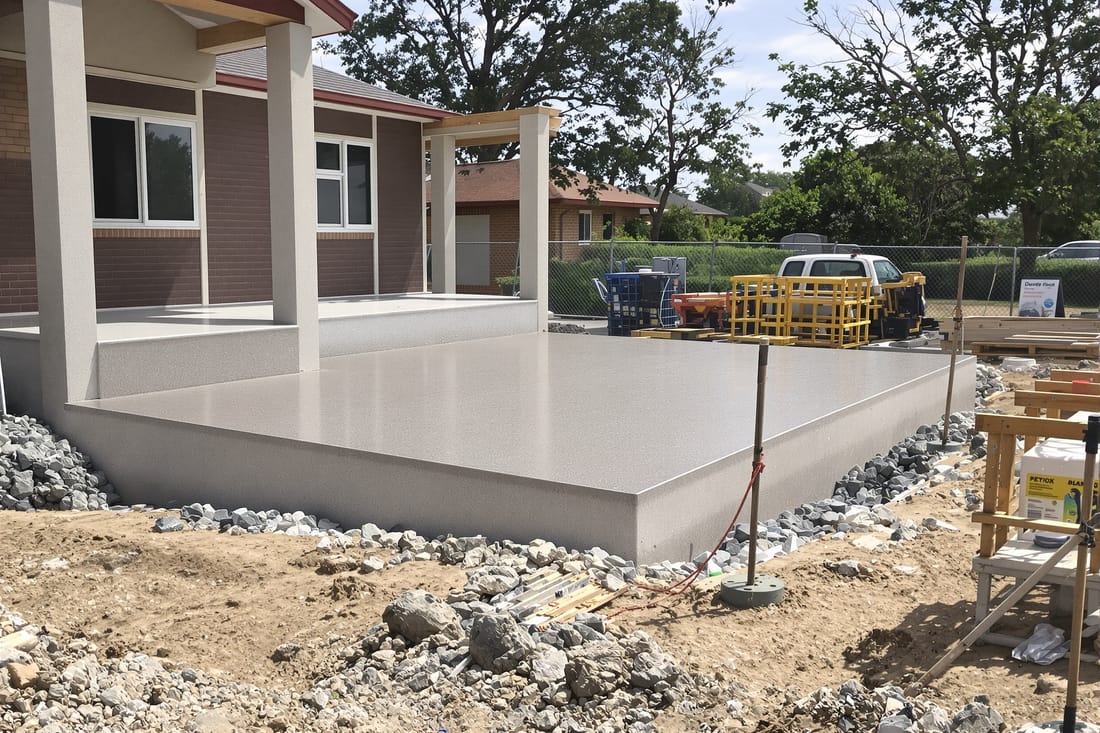
Commercial Concrete Slabs and Flatwork for Atlanta Businesses
Superior Concrete Atlanta installs and repairs commercial concrete slabs and flatwork for businesses across the Atlanta metro, from small retail buildouts to large warehouse floors and loading areas. We focus on the real-world needs of local property owners: durability in Georgia clay, performance in summer heat, and finishes that stand up to heavy foot and vehicle traffic.
A commercial concrete slab is more than a flat surface. It supports your building structure, racking systems, equipment, and customers. Done right, it drains correctly in our frequent storms, resists cracking from clay movement, and stays usable for years with minimal maintenance. Done wrong, it can cause trip hazards, water pooling, doors that bind, and expensive structural problems.
Our team helps you decide what type of slab and flatwork you actually need: conventional slab-on-grade, thickened edge slabs at exterior doors, machine pads, dumpster pads, drive lanes, or ADA compliant walkways and ramps. We coordinate with your architect, engineer, or GC when required, or help small business owners navigate a project from concept to completion for tenant improvements and site upgrades.
How We Design and Plan a Commercial Concrete Slab in Atlanta
Good commercial slab work in Atlanta starts with careful planning around site conditions and intended use. First, we evaluate soil conditions, access, drainage patterns, and existing structures. Much of metro Atlanta sits on dense red clay that holds water, and in some pockets, fill soil or loose topsoil can cause settlement. If needed, we recommend proof-rolling, undercutting soft spots, or adding a crushed stone base to create a stable platform.
Next, we talk load requirements and use. A slab for an office buildout is very different from a slab under pallet racks, forklifts, or box trucks. We confirm thickness and reinforcement based on expected loads and, if applicable, engineer drawings. Typical light commercial interior slabs range from 4 to 6 inches, while drive lanes, dumpster pads, and loading dock areas often need to be thicker and more heavily reinforced.
We also plan joints and drainage at this stage. Control joints are laid out to control where the slab will crack, instead of letting random cracks appear. We place joints at the right spacing for the slab thickness and shape, and we coordinate joint locations with doors, columns, and equipment pads so the floor functions well and looks intentional. For exterior flatwork we design slopes toward drains or appropriate discharge points so afternoon thunderstorms do not leave standing water at entry doors or walkways.
Finally, we schedule the work around your operations whenever possible. For retail suites, restaurants, or offices, we can phase work so other trades can stay productive. For active sites, we plan staging and traffic control so tenants, employees, and customers can reach your building safely while the slab work proceeds.
Materials, Mix Designs, and Finish Options for Commercial Flatwork
Superior Concrete Atlanta specifies concrete mixes and reinforcement that match the performance needs of your project and the Atlanta climate. For most commercial slabs we use a 3,000 to 4,000 psi mix. For heavy duty areas or engineered projects, higher strengths or special additives may be required. We consider slump (workability) and set time based on weather, access distance from the street, and type of finish.
Reinforcement can include welded wire mesh, deformed rebar, or fiber reinforcement, and many commercial projects use a combination. Wire mesh or fiber helps control surface cracking and curling, while rebar is placed where structural plans call for it, such as thickened edges, column pads, and heavily loaded areas. Our crews tie bars securely and maintain correct cover with chairs or dobies, which is critical for long term performance.
Finish options depend on how you plan to use the space. For interior slabs that will receive tile, vinyl, or epoxy, we typically provide a smooth, troweled finish with flatness appropriate for the flooring system. For warehouses and shops, we often recommend a hard trowel finish that is easier to keep clean and can later receive sealers or coatings. Exterior sidewalks and entrances usually get a broom finish for slip resistance when wet, which is important in Atlanta’s frequent rain. For drive approaches and loading areas, we balance texture for traction with the need for forklifts or dollies to roll smoothly.
If you plan to stain, polish, or seal the concrete later, we adjust our finishing sequence so the surface is compatible. We also consider color options or integral hardeners for high traffic public areas, such as restaurant patios, shopping center walkways, or courtyard slabs.
Our Step by Step Process for Commercial Slabs and Flatwork
From the first site visit to the final cure, our process is organized so your project moves forward predictably and safely.
1) Site assessment and layout: We verify dimensions, elevations, and reference points. In existing buildings we check door thresholds, existing floors, and utility locations. For new sites we confirm proposed top of slab elevations against surrounding grades to avoid water running into doorways or against foundation walls.
2) Excavation and base prep: We remove organic material and unstable soil to the required depth. A compacted granular base (often #57 stone or similar) is added where needed. Proper compaction is essential in metro Atlanta because clay expansion and contraction can telegraph into the slab if the base is inconsistent.
3) Forms and reinforcement: We set forms to the correct elevations and slopes, using sturdy formwork that will not bow under the weight of fresh concrete. Reinforcement is installed per plans, with correct spacing and overlaps. We also install sleeves or block-outs for plumbing, electrical, bollards, and anchor bolts so other trades can complete their work without cutting the new slab.
4) Concrete placement and finishing: We coordinate ready-mix deliveries to minimize delays and cold joints. Our crews place, screed, and bull float the concrete, then proceed through the right timing of finishing steps as it sets. For large areas we use ride-on or walk-behind power trowels to achieve the specified flatness and finish type. We cut or saw control joints at the proper depth and timing to help direct future shrinkage cracking into the joints.
5) Curing and early protection: Curing is critical in our hot Georgia summers, where rapid drying can cause surface shrinkage cracks and scaling. We use curing compounds, water curing, or a combination depending on the project. We set realistic timelines for when forklifts, racks, or vehicles can be placed on the slab so you do not damage the surface during its early strength gain.
Common Problems in Atlanta Commercial Slabs and How We Address Them
Many of the service calls we get are for issues in existing commercial flatwork that could have been prevented during the original installation. Understanding these problems helps you make better decisions on new work.
Settlement and voids: Poorly compacted fill or trapped organic material can decompose and create voids under a slab. Over time, forklift aisles or sidewalks may settle and crack. On new projects we focus heavily on subgrade prep and, when needed, work with geotechnical recommendations. For existing slabs with localized settlement, we can often remove and replace sections, or coordinate with specialty contractors for slab lifting if that is the best option.
Random cracking and curling: All concrete cracks to some degree, but random, wide cracks often result from inadequate joints, poor curing, or wrong reinforcement. Slab curling (edges rising) is a particular issue in large warehouse slabs with thin sections and rapid surface drying. We address these concerns through proper mix choice, joint layout, slab thickness, and curing methods suited to Atlanta’s temperature swings and humidity.
Drainage and slip hazards: In our climate, even a slight miscalculation in slope can leave water standing near entries, loading docks, or walkways. Over time, algae can grow and create slick spots. We carefully set grades and check slopes with levels and lasers during forming and finishing. For existing problem areas, we may recommend cutting new drains, installing overlays with corrected slopes, or replacing specific sections of flatwork.
Temperature and scheduling impacts: Atlanta’s summer heat and afternoon storms can be tough on finishing schedules. Concrete can set too fast in the sun, then storms can hit fresh surfaces. Our crews plan placements in suitable weather windows, use admixtures to control set times when appropriate, and protect fresh slabs with coverings or drainage paths if unexpected showers roll in.
Costs, Scheduling, and Why Local Experience Matters
Pricing for a commercial concrete slab in Atlanta depends on several specific factors: slab thickness and reinforcement, total square footage, the amount of formwork and base preparation needed, site access, and finish or flatness requirements. For example, an easily accessible 4 inch interior slab in a shell building will be less per square foot than a heavily reinforced loading dock slab with difficult access and complex forming.
Local building codes, inspections, and permitting also affect schedule and cost. Superior Concrete Atlanta is familiar with city and county requirements across the metro area, including the City of Atlanta, Fulton, DeKalb, Cobb, and Gwinnett. For projects that require engineering, we coordinate with your design team or refer you to engineers who understand local soil behavior and structural expectations.
Scheduling is planned to limit downtime for your business. For tenant improvements, we often coordinate with your general contractor to get slabs placed early so framing and MEP trades can move forward. For occupied properties such as retail centers or medical offices, we can phase work or schedule pours during off hours when feasible, subject to local noise regulations.
Local experience matters because concrete responds to climate and soil. Knowing how Atlanta’s red clay behaves when wet, how summer heat affects finishing and curing, and how quickly afternoon storms can form allows us to make practical decisions at each stage. Superior Concrete Atlanta uses that on the ground knowledge to deliver commercial flatwork that looks good, functions safely, and holds up under real business use.
If you are planning a new commercial concrete slab, replacing damaged flatwork, or expanding your facility, we can walk the site with you, explain your options in plain language, and provide a clear written proposal so you know exactly what you are getting and why it is specified that way.